
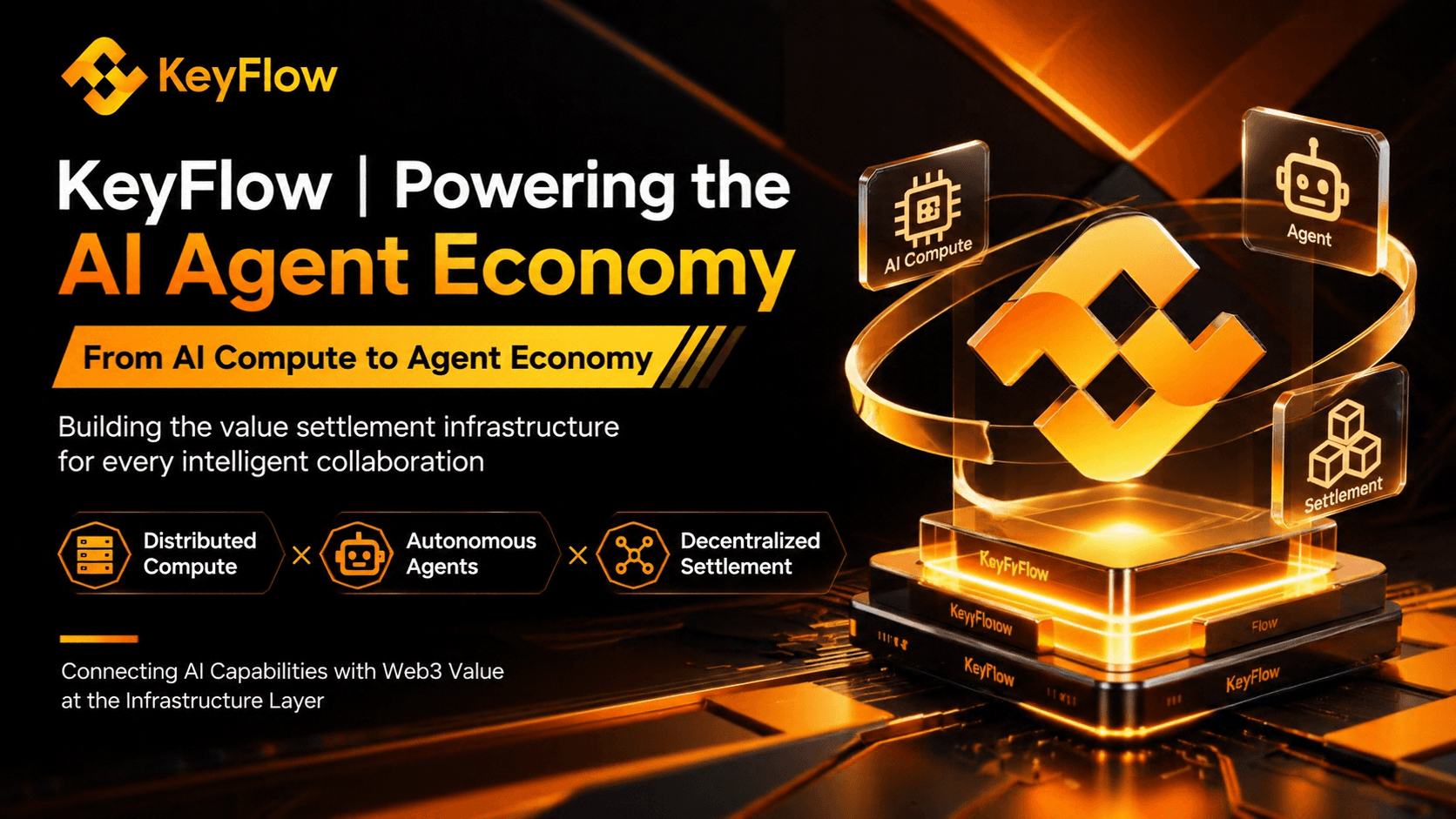
After AI evolved from the standalone breakthroughs of large language models (LLMs) to collaboration among swarms of autonomous agents, global technology and financial infrastructure is undergoing an unprecedented structural overhaul.
From the maturation of underlying distributed GPU compute networks to multi-agent systems making autonomous decisions in complex business scenarios, AI is evolving from a mere “productivity tool” into an “economic actor” capable of independent interaction. However, when hundreds of millions of AI agents begin autonomously fetching data, procuring compute, coordinating services, and allocating assets, traditional financial clearing systems and general-purpose public chain architectures run into significant efficiency and trust bottlenecks.
Against this backdrop, KeyFlow has developed and launched the Agent Value Clearing Network, a decentralized clearing network purpose-built for AI agents, designed to provide high-concurrency, low-friction, transparent, and verifiable clearing and value settlement services for distributed compute supply and the autonomous agent economy.
I. The Evolution of the Era: From Compute Infrastructure to Agent Economies
Over the past several years, the AI industry has focused mainly on algorithmic progress and stacking compute hardware. With the development of Decentralized Physical Infrastructure Networks (DePIN) and distributed compute routing technology, scattered GPU resources around the world are being efficiently aggregated into a borderless intelligent computing base layer.
However, compute is a physical resource and can only be turned into real commercial value through the application layer. The rise of AI agents fills this missing link:
● From passive response to autonomous decision-making: Agents no longer merely answer questions; based on preset goals, they can autonomously decompose tasks, call external APIs, and collaborate with other agents.
● From single services to economic interaction: In the course of executing tasks, agents generate frequent demand for micropayments and compute transactions. For example, a data analysis agent needs to buy temporary inference resources from a compute node while paying a data retrieval fee to a knowledge base agent.
● The birth of Agentic GDP: As agent-to-agent (A2A) collaboration networks expand, the total volume of economic activity driven autonomously by agents is growing rapidly, forming a brand-new “Agentic Economy.”
The explosion of the agentic economy places entirely new demands on underlying asset flows and fund settlement: future clearing networks must offer permissionless access, algorithmic automated execution, and fully transparent fund flows.
II. The Structural Bottleneck: The “Clearing Gap” in Agent Economic Interaction
Despite significant progress in distributed compute and agent development frameworks, value clearing between agents still faces three core bottlenecks at the infrastructure layer:
1. Lag in Traditional Settlement Systems
Traditional banking and cross-border payment networks are built on fiat settlement and centralized compliance review, with settlement cycles typically measured in days (T+1/T+2) and high transaction fees. For AI agent interaction networks that demand second-level response and high-frequency micro-transactions, the traditional financial system is architecturally incompatible.
2. Performance and Mechanism Mismatch in General-Purpose Blockchains
Existing general-purpose public chains, while decentralized and programmable, suffer from fragmented liquidity and underdeveloped clearing logic when handling agent clearing. What agents need is dedicated infrastructure focused on “clearing and automated settlement,” not a general-purpose smart contract platform hosting a wide variety of complex applications.
3. Absence of Trust and Value Verification Mechanisms
In scenarios where agents transact autonomously, both counterparties are code-driven programs and lack the credit endorsement found in traditional commerce. How to ensure the security of fund custody, the verifiability of compute output, and the smoothness of yield settlement has become the core obstacle limiting large-scale commercial deployment of agents.
III. KeyFlow’s Strategic Solution: Building a Decentralized Clearing Network
Facing the clearing gap in the agent economy, KeyFlow takes the “AI Agent Decentralized Clearing Network” as its core positioning, using underlying smart contract technology and innovative clearing mechanisms to provide the global AI ecosystem with stable, efficient, and sustainable value clearing services.
KeyFlow’s architecture is built around four dimensions: compute connectivity, intelligent clearing, asset deflation, and smooth settlement:
1. Direct USDT Participation Lowers the Barrier to Intelligent Clearing
To eliminate liquidity friction in traditional Web3 interactions, the KeyFlow clearing network allows users and institutions to participate in compute staking and clearing custody directly with USDT, without first buying the spot token on the secondary market. This design significantly lowers the barrier for external compute capital and AI applications to connect to the KeyFlow network, enabling real-time, seamless integration between on-chain capital and the value of AI compute.
2. 100% Contract-Driven Buyback and Permanent Burn Mechanism
On the long-term sustainability of the economic model, KeyFlow introduces a rigid deflationary clearing logic. All funds that participate in compute custody via USDT are used by decentralized smart contracts to automatically place buy orders for KEY tokens on the secondary market, with 100% of the purchased tokens sent to an irreversible black-hole burn address.
● Sustained active buy pressure: Converts the clearing network’s business flow directly into market buying momentum, ensuring the token’s value is tightly coupled to the scale of network clearing activity.
● Rigid supply contraction: Continuously reduces the total circulating supply of KEY tokens through the permanent burn mechanism, forging a solid deflationary foundation for the clearing network.
3. Equal Principal-and-Interest, Smoothed Daily Release
To ensure predictable clearing yields and stable system operation, KeyFlow adopts a financial-grade “equal principal-and-interest, daily release” calculation model.
● Based on the staking period chosen by the participant (such as 180, 360, or 540 days), the network automatically applies the corresponding boost coefficient (+15%, +30%, +45%).
● Principal and yield are not settled as a lump-sum windfall at maturity, but converted into fixed daily amounts that are released smoothly. This design effectively dampens market volatility and gives participants a long-term, stable cash flow expectation.
4. Tiered Ecosystem Order Bonus
To encourage deep alignment with long-term capital and large compute nodes, KeyFlow has set a strict tiered order bonus policy during campaigns and the early network expansion phase:
● For long-term participation orders with a term of 360 days or more, the network provides an additional order bonus of 5% to 15% (a 5% bonus for 1,000–4,999 USDT; 10% for 5,000–9,999 USDT; 15% for 10,000 USDT and above).
● The bonus portion is uniformly accrued on a 360-day cycle and likewise follows the smoothed daily release rule, keeping network growth tightly in step with long-term fund lock-up periods.
IV. Use Cases and Ecosystem Synergy
KeyFlow is not merely a standalone clearing protocol but a connective tissue spanning multiple technology domains. Through standardized clearing interfaces, KeyFlow is empowering three core areas:
1. DePIN Distributed Compute Networks
In decentralized compute, KeyFlow acts as settlement middleware, helping hardware providers and compute buyers establish automated clearing contracts, enabling on-demand GPU compute access and real-time daily settlement of yield.
2. PayFi (Payment Finance) and AI Autonomous Payments
In scenarios where AI agents independently execute procurement or payments, KeyFlow provides on-chain custody and automated clearing services, enabling agents to complete high-frequency micropayment settlement via smart contracts at zero trust cost.
3. Multi-Agent Business Ecosystems
In complex supply chain management, quantitative financial strategies, and intelligent customer service networks, KeyFlow provides a unified value measurement and clearing standard for different agent roles, moving multi-agent collaboration from concept to commercial deployment.
V. Summary and Outlook
As AI continues to evolve toward autonomy, networking, and economization, infrastructure competition has shifted from sheer “compute scale” to “clearing efficiency and collaborative capability.”
By building a transparent, verifiable decentralized clearing network with rigid deflationary characteristics, KeyFlow bridges the gap between distributed compute, autonomous agents, and value flow. Going forward, KeyFlow will continue to deepen the development of its underlying protocol and work closely with global compute networks, agent development platforms, and the decentralized finance ecosystem, striving to become the indispensable foundational value clearing standard of the AI era.